Prediction Review for 2025
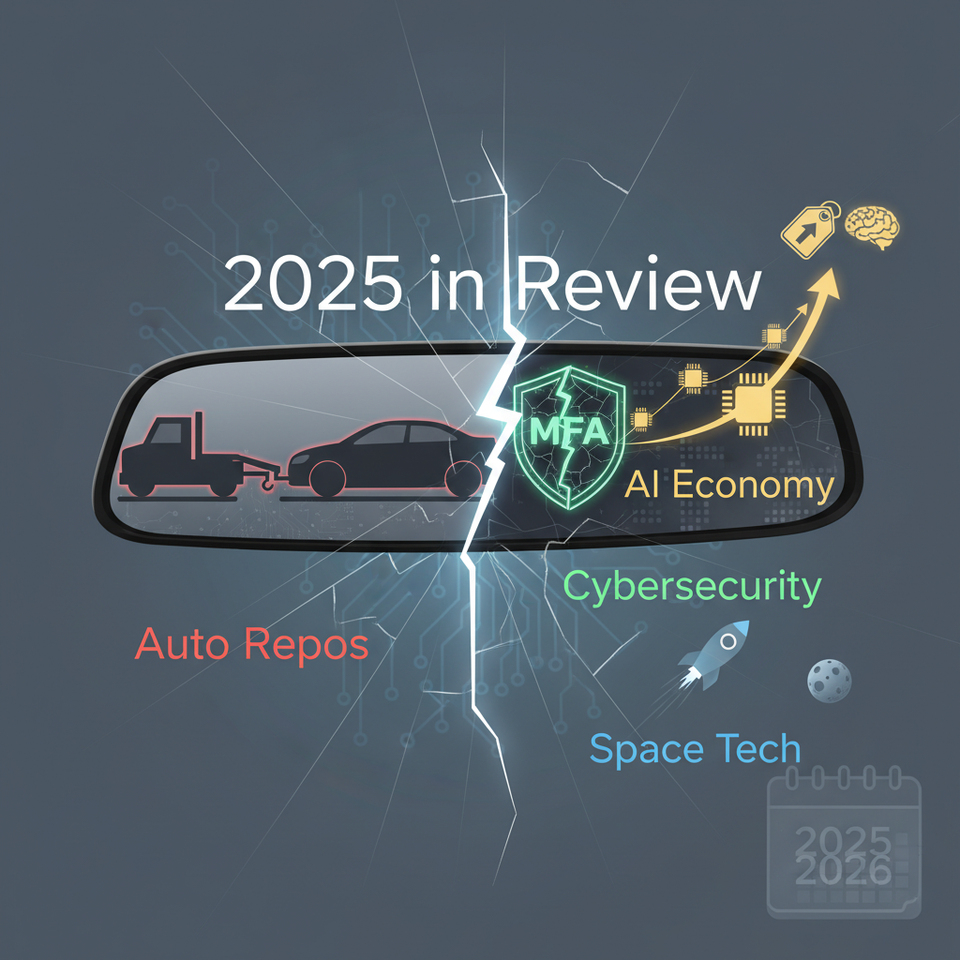
So last year, I did the 2025 Predictions, let’s see how I did.
Cars
Did car companies struggle in 2025?
Curiously they didn’t struggle, they maintained relatively strong growth in a somewhat weakening demand market due to high interest rates and other uphill struggles from both a demand and supply side.
Not trying to kick it down the road, but 2025 also had some of the highest repossessions since The Great Recession, with most of these happening at the back half of 2025. This dovetails nicely into the economy, but this trend was opposite of what I thought of the car industry this year.
Economy
Did the economy succeed?
Yes, yes the economy showed a level of resilience this year, but is showing some disappointments.
- Unemployment - Grew from 4.0% to 4.4%. While still lower than the median of 5% in general for the US, it is a concerning rise, especially as more people move to gig work, and the overall unemployment number does not consider part time as “unemployed” even though livable wages on part time work is questionable at best.
- GDP Growth - Up to about 5.1% this year, which grew way more than was expected with many economists thinking this year was gonna flop. I had said that the economy was going to stay strong solely because of AI, that seemed to be the case with AI now taking almost 35% of the market cap of S&P. Concerning.
- Inflation - Inflation stayed within the market requirements, thanks to the wonderful work of the current Fed, including the Fed chair Jerome Powell, hanging around 2.7%. A little higher than the 2% they were aiming, but within the 3% high.
Nothing fell apart, no economic downslide, but the undercurrent was very strongly in the negative direction.
Cybersecurity
Did cybersecurity see a great boon with AI?
This one’s a bit more subjective, but from what I’ve heard in various podcasts and experiences, I think for 2025, the AI side did not succeed as much as leaders were hoping. AI did make good inroads to improving workloads for an over-utilized industry, but the sense I felt was that it was pretty underwhelming. AI did not make quite the splash companies were hoping, and I think it follows the same general trend of most AI products at the moment. Lots of hype, lots of promises, but lacks on the execution and outcome oriented results. Perhaps because the market doesn’t understand what’s actually needed. We got lots of bolt-on accessories that in my opinion did not move the needle to a more secure future.
Still have major breaches happening because of MFA, which has been out for over a decade… When that stops, then I think cybersecurity has seen a shift.
AI
Legislation
What did legislation look like?
There’s been a bit of back and forth here. While legislation is still strong, one of the biggest moves was for the federal government to attempt to block any state legislation, looking instead to federal government to create legislation around how AI is legislated.
The problem is, no further frameworks or federal laws around how AI is to be legislated has been put forward. AI is moving fast, and states like California, Colorado and New York are getting legislation started to deal with things like AI safety. We will see how it changes in 2026, perhaps the balance will swing again. For the most part, I feel like it wasn’t as dire as I was expecting, but still, with AI moving as fast as it is, what I’m afraid of is companies will attempt to lobby for the laws to work around their business models rather than laws that will keep users safe, and their privacy respected.
Profitability
Did profitability requirements change the way businesses implemented AI?
There was definitely changes to how companies billed for AI. Many companies realized that in order to afford the expensive capex investment and maintain their edge in an increasingly competitive market, they had to change their billing methods. Lets take a look at two companies that changed their pricing in the name of AI.
Microsoft
Microsoft forced all M365 Office users into a more expensive product, justifying the price increase by expanded product offering, Copilot. The price increase was significant too, going from $99/yr for a family account to $130/yr, a 30% price increase.
The only selling point? Copilot.
Pricing that out, with about 300 million subscribers with price increases around 30-40%, they gained $2 BILLION just from increasing the price of their personal/family plan ALONE. Moving across the entire industry with similar price increases, looking at $20 BILLION in revenue growth, just to fund AI. No better product offering, nothing significant for most people. Just AI.
Notion
Looking at my other favorite tool, one that I am currently writing this blog on.
Notion used to charge $10/mo for their AI add-on. This was something I paid for and got value out of.
They removed this feature in the middle of 2025 due to “expanded capabilities” and instead put it not in their lowest tier, but it in their Business tier, and increased the price of their business tier to $20/mo, essentially an 11% increase, not including those who would be required to switch from the personal plan to business plan or Free plan to now the Business plan to get the same features they were paying $10/mo for.
Business Effectiveness
Did customers see the benefit of AI?
While businesses are cutting people left right and center based on AI improvements that no longer require humans, I believe those cuts are based on a continuing retraction of their massive growth during COVID, not on the improvements of AI.
My belief is that businesses saw an opportunity to cut costs and decided to blame AI for the cuts. Not saying AI wouldn’t have an impact on employee effectiveness, it certainly has given me a confidence and productivity boost I didn’t have before, but not quite as much as they are claiming.
Now, I do think the biggest winners this space who’s successfully implemented AI are those businesses who had lost a lot of productivity due to an overwhelming amount of overhead to produce. Think of all the emails to purchase a piece of hardware that may be needed to improve business. If you can have AI do the talking for you, its a time improvement, even if the process overhead hadn’t been revisited and removed.
Problem is, for small businesses who don’t see value in AI because they have their process and its efficient enough for their uses, they won’t see a benefit (nor will the big AI developers get any money either).
The problem for AI companies to think of now, is that AI REQUIRES documentation and work best on documented problem/solutions that have already been resolved or somewhat resolved and can be matched with some correlative checks. Hallucinations happen when documentation is light and processes don’t provide solutions. That makes small businesses who typically don’t have a lot of documentation or required processes to follow really difficult to provide AI “business improvements”.
We started to see the cracks of business effectiveness at the end of 2025, early 2026 when Microsoft has been beaten down by critics and investors, believing their capex outgrew AI growth. We will see in 2026 what that means.
AI Future
Now, the exciting stuff. What is good for AI?
AI is getting REALLY good at thinking. Instead of being your biggest champ, it can now be your biggest critic. Instead of saying great idea, I’ve had it question what I’ve asked it while it asks for clarification and say no, that won’t work.
I also think AI will be much more integral in the way we interact with technology. I’m sure AR glasses will be the biggest winners here. OpenClaw really shows off its capabilities of completing tasks, but requires a fair bit of massaging to get it to produce. Once these tools become mainstream, I’m excited to wear a set of glasses that I can talk to and it being able to act on my behalf.
Quantum
While the press kinda died off in 2025 there were quite a bit of great progress made in 2025 in quantum, with much progress made on quantum readiness, preparing for the inevitable move toward quantum, quantum hardening, hardening for the eventual future of quantum, and a few other great strides.
While always excited for breakthroughs, this did kinda fall a bit in 2025, but quantum is hard, and will have its moments. Until then AI and traditional computing will be here to stay.
BONUS: Space
Ohh baby, we got moving with Artemis II for 2026, more to say about that, but the fact it didn’t get delayed more is great news. Really excited about that.
In other news, there were a bunch of cool things that happened in 2025.
- Firefly Aerospace landed on the moon, the first commercial moon landing.
- IIS hit 25 years in space!
- 3I/ATLAS floated past the earth in curious order.
Bunch of other stuff happened but still a great year for space news.

Member discussion